The Hidden Problem With Indian College Rankings
Indian college rankings may look authoritative, but they often fail to measure what truly matters to students — real placements, practical learning, mentorship, and career growth. Behind the glossy numbers lies a system that can be surprisingly disconnected from student reality.

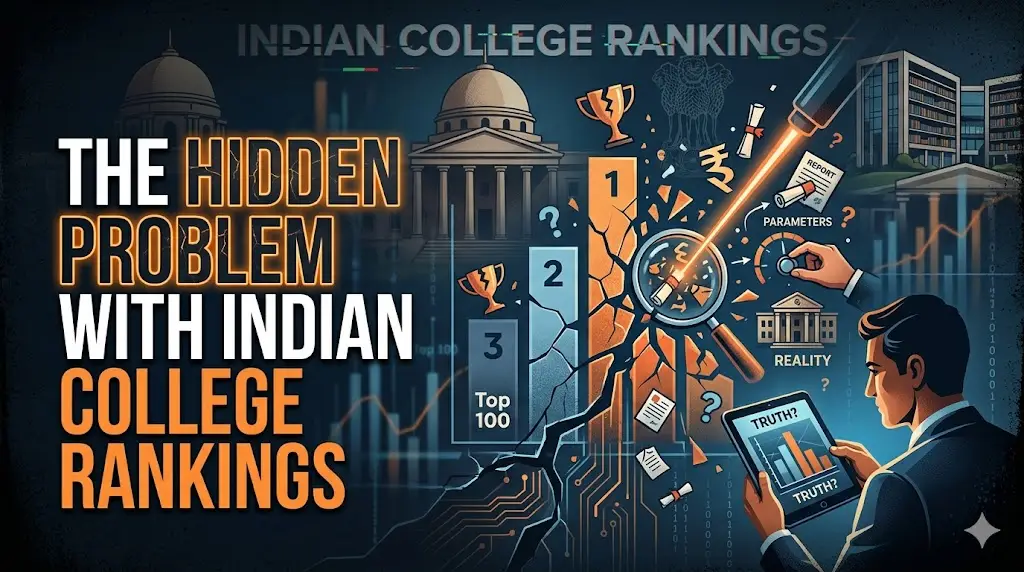
Every year, millions of Indian students make life-changing decisions based on rankings they barely understand.
Rank #12? Fantastic. Parents celebrate.
Rank #37? Must be cursed. Stay away at all costs.
Parents send ranking PDFs to each other like sacred scriptures. Coaching centers worship them. Colleges print them on giant banners large enough to be visible from orbit. And students? Students stare at them at 2 AM wondering whether a numbered list on the internet is about to decide their entire future.
Here’s the uncomfortable truth:
Indian college rankings are useful — but they are also incredibly incomplete.
And sometimes, hilariously disconnected from what students actually care about.
The Great Indian Ranking Obsession
Indian students are raised to believe one simple formula:
Better rank = better life.
Simple. Clean. Weirdly dangerous.
A college could have:
- Terrible teaching
- Outdated labs
- Placement statistics held together by prayer
- WiFi slower than emotional recovery after JEE results
But the moment it says:
“Ranked #18 in India”
suddenly everyone behaves like the gates of IIT Heaven just opened.
The issue is not that rankings exist. Rankings are useful for comparing institutions at scale.
The real problem is this:
Most students do not actually understand what rankings are measuring.
And honestly, it is rarely happiness.
The NIRF Effect and the SEO Trap
Students searching for the best colleges in India often rely heavily on NIRF rankings, private ranking agencies, placement advertisements, and social media opinions.
But choosing the right college requires looking beyond ranking positions.
Many students assume that a higher-ranked institution automatically guarantees:
- Better placements
- Better teaching
- Better opportunities
- Better career outcomes
Unfortunately, real life is slightly more complicated than a PDF leaderboard.
Bigger Campus = Better College?
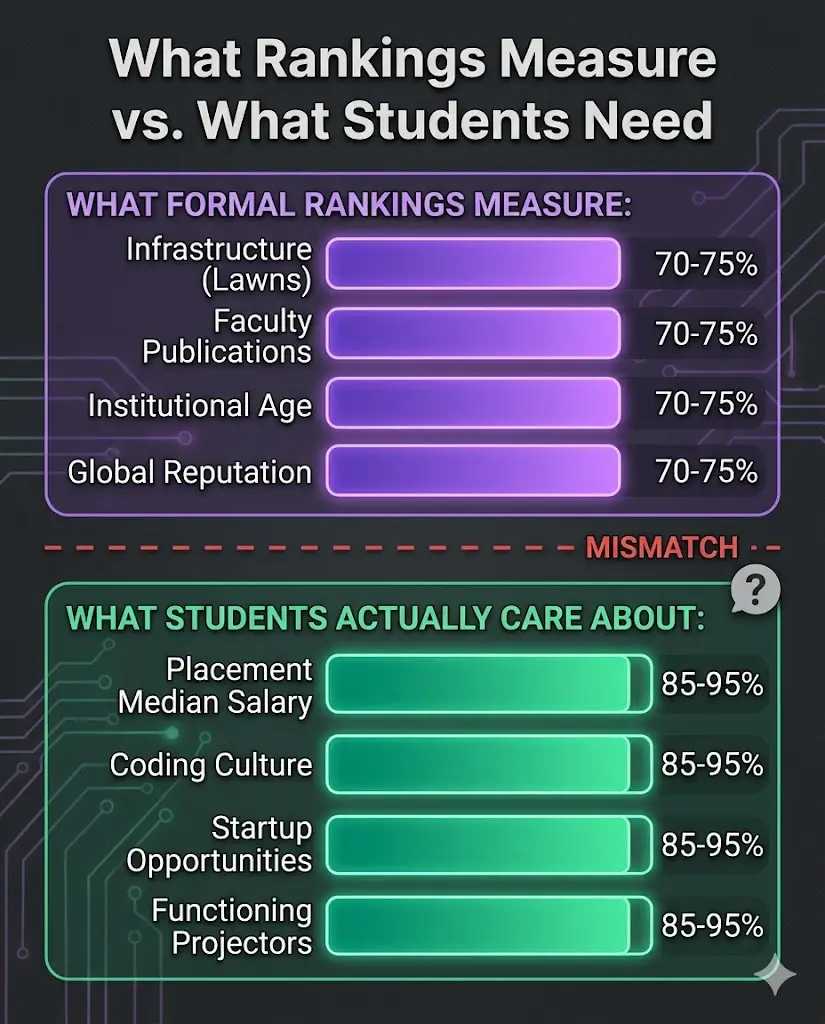
Many ranking systems reward things like:
- Infrastructure
- Research publications
- Faculty-student ratio
- Institutional age
Which sounds fair.
Until you realize students often care more about:
- Placements
- Internships
- Startup culture
- Coding opportunities
- Industry exposure
- Whether the classroom projector works without ritual sacrifice
A college may have:
- Acres of green lawns
- Decorative fountains
- Marble statues
- A brochure shot like a Netflix documentary
Meanwhile, students are learning programming from a 2014 YouTube playlist.
But the lawn? Spectacular.
The Placement Package Circus
Every admission season, colleges proudly announce:
“Highest package: ₹48 LPA!”
And students react like startup investors discovering gold.
But almost nobody asks:
- Was it only one student?
- Was it an off-campus placement?
- Was it an international role?
- What is the median salary?
- How many students were actually placed?
The median package matters far more than the highest package.
Not the mythical engineering student who solved 900 LeetCode problems before breakfast and got hired by a Silicon Valley company while the rest of the batch is still updating LinkedIn bios with:
“Open to Work.”
Some placement reports feel less like transparent data and more like creative writing assignments with Excel sheets.
The LinkedIn Test
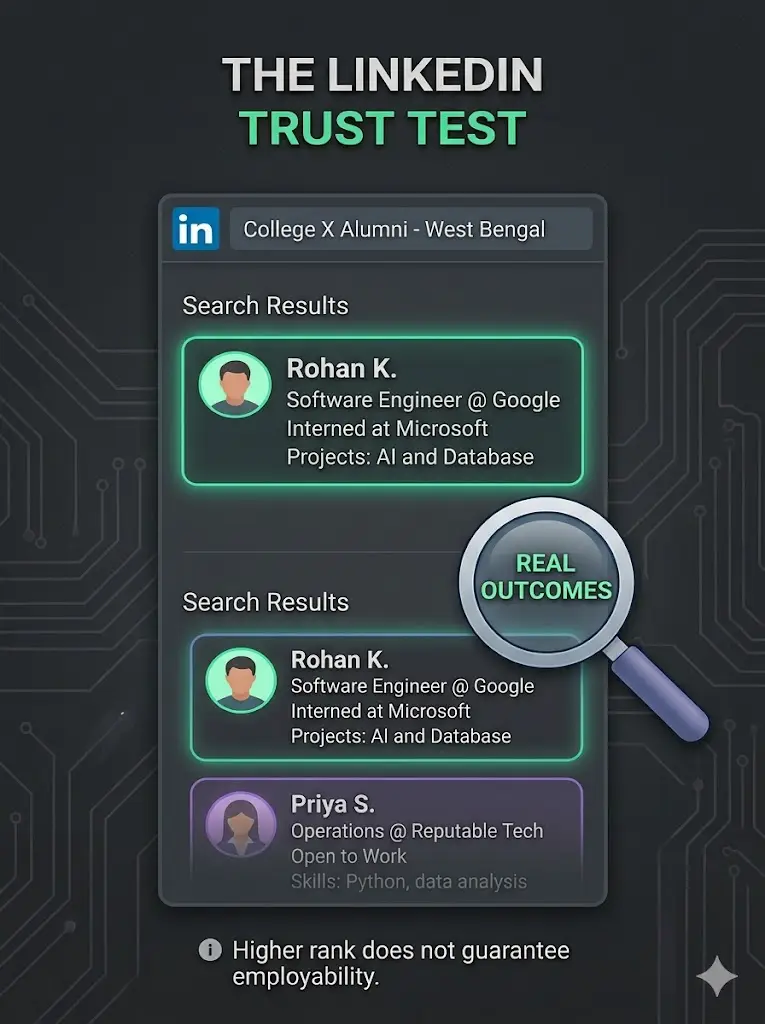
Want to know whether a college is actually producing strong outcomes?
Open LinkedIn.
Search for alumni from that college.
Check:
- Where graduates are working
- What skills they have
- What internships they completed
- What projects they built
- How their careers evolved after five years
Because sometimes a lower-ranked college quietly produces highly employable students while a top-ranked institution survives mostly on reputation from 2009.
Rankings Rarely Measure Student Reality
Here’s the biggest flaw.
Most rankings barely measure:
- Teaching quality
- Mentorship
- Practical learning
- Mental health support
- Peer culture
- Academic pressure
- Freedom to explore
- Startup opportunities
- Real student experience
And yet these are the things that shape careers and personalities for life.
Students do not just study in colleges.
They survive them.
The Brand Bias Nobody Talks About
Older metro-based institutions naturally dominate rankings because they already have:
- Reputation
- Funding
- Alumni networks
- Visibility
- Legacy advantage
Meanwhile, newer and innovative colleges often struggle to gain recognition.
It is basically social media verification, but for education.
The already famous become even more famous.
Rankings Can Be Optimized
Colleges are not unaware of ranking systems.
When ranking frameworks reward certain metrics, institutions naturally focus heavily on improving those exact numbers.
Which can sometimes lead to:
- Paperwork optimization
- Quantity over quality research
- Inflated reporting
- Strategic storytelling
Corporate people call this:
“Alignment with evaluation frameworks.”
Normal humans call it:
“Gaming the system.”
So What Should Students Actually Check?
Students need to become investigators instead of brochure collectors.
Before choosing a college, check:
- Median placement salary
- Internship culture
- Alumni career growth
- Faculty accessibility
- Industry exposure
- Coding communities
- Startup ecosystem
- Real student reviews
- Return on investment
- Location advantage
And most importantly:
Watch student vlogs.
Nothing reveals reality faster than a tired third-year student recording:
“Hostel food review part 17.”
That is real research.
The Future of College Search Is Changing
Today’s students no longer rely only on rankings.
They search through:
- YouTube
- Discord communities
- AI tools
- Student creators
- Review platforms
Why?
Because students want authenticity.
Not glossy brochures featuring students pretending to brainstorm around laptops that are clearly switched off.
Modern students understand something important:
A college is not just a rank. It is an ecosystem.
Final Thoughts
College rankings are not useless.
But they are not divine truth either.
A ranking should be the beginning of research — not the final decision.
Because after four years, nobody says:
“Thank God our NAAC score looked beautiful.”
They remember:
- The opportunities
- The people
- The pressure
- The culture
- The growth
- Whether the college actually prepared them for the real world
And honestly?
That can never be fully measured by a number beside a college name..